EasyExam
EasyExam
EasyExam
A modern, intuitive ecosystem for managing dental clinics.
A modern, intuitive ecosystem for managing dental clinics.
A modern, intuitive ecosystem for managing dental clinics.
Summary
Summary
Summary
Summary
Summary
Project Overview
Project Overview
Project Overview
Project Overview
Project Overview
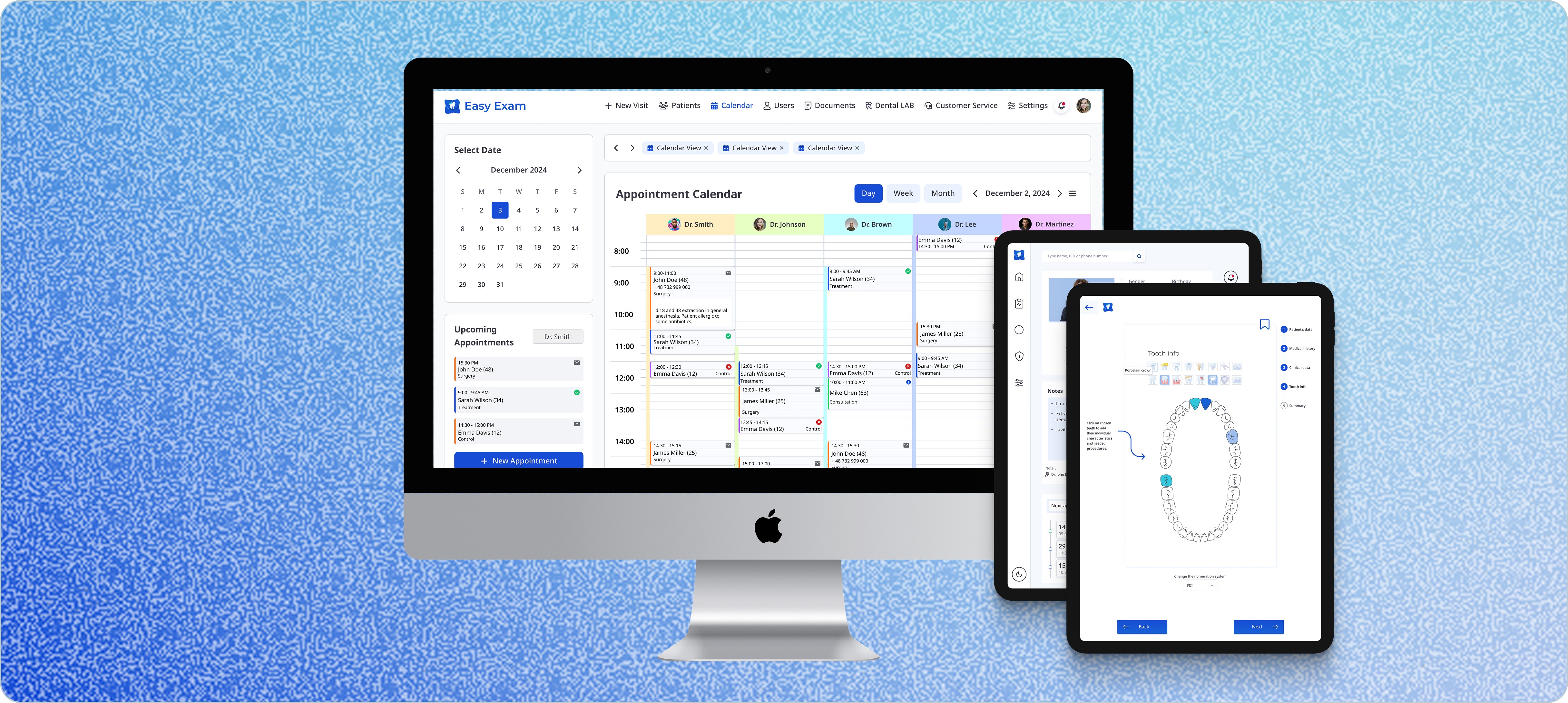
EasyExam.com is a comprehensive digital platform designed to streamline daily operations in dental clinics, enabling staff to manage appointments, settle visit payments, create complete electronic patient charts (with PDF export), and upload medical documentation. The aim was to create an all-in-one, seamless system that brings clarity to the daily workflow of dentists, assistants, hygienists, reception staff, and managers—user groups that often struggle with outdated, unintuitive tools used in the clinical environment.
EasyExam.com is a comprehensive digital platform designed to streamline daily operations in dental clinics, enabling staff to manage appointments, settle visit payments, create complete electronic patient charts (with PDF export), and upload medical documentation. The aim was to create an all-in-one, seamless system that brings clarity to the daily workflow of dentists, assistants, hygienists, reception staff, and managers—user groups that often struggle with outdated, unintuitive tools used in the clinical environment.
EasyExam.com is a comprehensive digital platform designed to streamline daily operations in dental clinics, enabling staff to manage appointments, settle visit payments, create complete electronic patient charts (with PDF export), and upload medical documentation. The aim was to create an all-in-one, seamless system that brings clarity to the daily workflow of dentists, assistants, hygienists, reception staff, and managers—user groups that often struggle with outdated, unintuitive tools used in the clinical environment.
EasyExam.com is a comprehensive digital platform designed to streamline daily operations in dental clinics, enabling staff to manage appointments, settle visit payments, create complete electronic patient charts (with PDF export), and upload medical documentation. The aim was to create an all-in-one, seamless system that brings clarity to the daily workflow of dentists, assistants, hygienists, reception staff, and managers—user groups that often struggle with outdated, unintuitive tools used in the clinical environment.
Problem Statement
Problem Statement
Problem Statement
Problem Statement
Problem Statement
Existing dental management systems were fragmented, unintuitive, overloaded with unnecessary functionalities, and visually outdated. Many dental professionals struggled with slow navigation, inconsistent layouts, complex appointment calendars, and cumbersome medical documentation workflows. These issues not only reduced productivity but also created unnecessary stress and increased the risk of errors. As someone with a dental background, I understood firsthand how vital quick access, clarity, and proper information flow are in a dental practice. This insight shaped the design direction: creating a system that prioritizes efficiency, usability, accuracy, and peace of mind for clinical staff.
Existing dental management systems were fragmented, unintuitive, overloaded with unnecessary functionalities, and visually outdated. Many dental professionals struggled with slow navigation, inconsistent layouts, complex appointment calendars, and cumbersome medical documentation workflows. These issues not only reduced productivity but also created unnecessary stress and increased the risk of errors. As someone with a dental background, I understood firsthand how vital quick access, clarity, and proper information flow are in a dental practice. This insight shaped the design direction: creating a system that prioritizes efficiency, usability, accuracy, and peace of mind for clinical staff.
Existing dental management systems were fragmented, unintuitive, overloaded with unnecessary functionalities, and visually outdated. Many dental professionals struggled with slow navigation, inconsistent layouts, complex appointment calendars, and cumbersome medical documentation workflows. These issues not only reduced productivity but also created unnecessary stress and increased the risk of errors. As someone with a dental background, I understood firsthand how vital quick access, clarity, and proper information flow are in a dental practice. This insight shaped the design direction: creating a system that prioritizes efficiency, usability, accuracy, and peace of mind for clinical staff.
Existing dental management systems were fragmented, unintuitive, overloaded with unnecessary functionalities, and visually outdated. Many dental professionals struggled with slow navigation, inconsistent layouts, complex appointment calendars, and cumbersome medical documentation workflows. These issues not only reduced productivity but also created unnecessary stress and increased the risk of errors. As someone with a dental background, I understood firsthand how vital quick access, clarity, and proper information flow are in a dental practice. This insight shaped the design direction: creating a system that prioritizes efficiency, usability, accuracy, and peace of mind for clinical staff.
Platform
Platform
Platform
Platform
Platform
Responsive Website
Responsive Website
Responsive Website
Responsive Website
Services
Services
Services
Services
Services
UX/UI Design
UX/UI Design
UX/UI Design
UX/UI Design
User Research
User Research
User Research
User Research
Usability studies
Usability studies
Usability studies
Usability studies
Prototyping
Prototyping
Prototyping
Prototyping
A/Bn Testing
A/Bn Testing
A/Bn Testing
A/Bn Testing
Goal
Goal
Goal
Goal
Goal
The goal was to design a clean, intuitive, and efficient tool tailored specifically to the needs of dental professionals— one that organizes clinic operations into a coherent digital ecosystem with a strong emphasis on excellent UX. The platform needed to simplify appointment scheduling, streamline patient records, ensure seamless documentation management, and offer a future-proof foundation for extending features as clinics grow and evolve.
The goal was to design a clean, intuitive, and efficient tool tailored specifically to the needs of dental professionals— one that organizes clinic operations into a coherent digital ecosystem with a strong emphasis on excellent UX. The platform needed to simplify appointment scheduling, streamline patient records, ensure seamless documentation management, and offer a future-proof foundation for extending features as clinics grow and evolve.
The goal was to design a clean, intuitive, and efficient tool tailored specifically to the needs of dental professionals— one that organizes clinic operations into a coherent digital ecosystem with a strong emphasis on excellent UX. The platform needed to simplify appointment scheduling, streamline patient records, ensure seamless documentation management, and offer a future-proof foundation for extending features as clinics grow and evolve.
The goal was to design a clean, intuitive, and efficient tool tailored specifically to the needs of dental professionals— one that organizes clinic operations into a coherent digital ecosystem with a strong emphasis on excellent UX. The platform needed to simplify appointment scheduling, streamline patient records, ensure seamless documentation management, and offer a future-proof foundation for extending features as clinics grow and evolve.
My role
My role
My role
My role
My role
As the UX/UI Designer with experience in both digital product design and dentistry, I oversaw the product from discovery to iteration. I conducted research and competitor audits, gathered insights from dental professionals, mapped the information architecture, and created wireframes that accurately reflected real clinical workflows. I transformed these into high-fidelity mockups and interactive prototypes, tested the system with real clinic staff, and conducted in-depth interviews to refine usability. In the final stage, I continued improving the solution and shaping the long-term vision for future development.
As the UX/UI Designer with experience in both digital product design and dentistry, I oversaw the product from discovery to iteration. I conducted research and competitor audits, gathered insights from dental professionals, mapped the information architecture, and created wireframes that accurately reflected real clinical workflows. I transformed these into high-fidelity mockups and interactive prototypes, tested the system with real clinic staff, and conducted in-depth interviews to refine usability. In the final stage, I continued improving the solution and shaping the long-term vision for future development.
As the UX/UI Designer with experience in both digital product design and dentistry, I oversaw the product from discovery to iteration. I conducted research and competitor audits, gathered insights from dental professionals, mapped the information architecture, and created wireframes that accurately reflected real clinical workflows. I transformed these into high-fidelity mockups and interactive prototypes, tested the system with real clinic staff, and conducted in-depth interviews to refine usability. In the final stage, I continued improving the solution and shaping the long-term vision for future development.
Impact
Impact
Impact
Impact
Impact
The redesigned platform brought measurable improvements to everyday clinical workflows, helping dental teams work more efficiently and with fewer errors. Key outcomes include:
Simplified navigation that reduced time spent searching for patient information
More intuitive appointment scheduling, enabling faster and more accurate bookings
Streamlined creation and management of electronic patient charts
Faster and clearer documentation uploads thanks to improved file handling
Reduced cognitive load for staff using the system throughout the day
Increased adoption and satisfaction among clinic employees previously discouraged by complex software
A scalable foundation for expanding functionalities as clinics grow
The redesigned platform brought measurable improvements to everyday clinical workflows, helping dental teams work more efficiently and with fewer errors. Key outcomes include:
Simplified navigation that reduced time spent searching for patient information
More intuitive appointment scheduling, enabling faster and more accurate bookings
Streamlined creation and management of electronic patient charts
Faster and clearer documentation uploads thanks to improved file handling
Reduced cognitive load for staff using the system throughout the day
Increased adoption and satisfaction among clinic employees previously discouraged by complex software
A scalable foundation for expanding functionalities as clinics grow
The redesigned platform brought measurable improvements to everyday clinical workflows, helping dental teams work more efficiently and with fewer errors. Key outcomes include:
Simplified navigation that reduced time spent searching for patient information
More intuitive appointment scheduling, enabling faster and more accurate bookings
Streamlined creation and management of electronic patient charts
Faster and clearer documentation uploads thanks to improved file handling
Reduced cognitive load for staff using the system throughout the day
Increased adoption and satisfaction among clinic employees previously discouraged by complex software
A scalable foundation for expanding functionalities as clinics grow
The redesigned platform brought measurable improvements to everyday clinical workflows, helping dental teams work more efficiently and with fewer errors. Key outcomes include:
Simplified navigation that reduced time spent searching for patient information
More intuitive appointment scheduling, enabling faster and more accurate bookings
Streamlined creation and management of electronic patient charts
Faster and clearer documentation uploads thanks to improved file handling
Reduced cognitive load for staff using the system throughout the day
Increased adoption and satisfaction among clinic employees previously discouraged by complex software
A scalable foundation for expanding functionalities as clinics grow
Design process
Design process
Design process
Design process
Design process
STEP I
STEP I
STEP I
STEP I
STEP I
Discovery, Insights Gathering & Competitive Audit
Discovery, Insights Gathering & Competitive Audit
Discovery, Insights Gathering & Competitive Audit
Discovery, Insights Gathering & Competitive Audit
The project began with an in-depth research phase focused on understanding the daily realities of dental clinic work. I conducted interviews and collected insights from dentists, assistants, hygienists, and receptionists to identify their biggest frustrations and inefficiencies when using traditional clinic software. I also performed a detailed competitor audit to pinpoint common UX issues such as overcomplicated calendars, poor documentation workflows, and inconsistent navigation structures. This stage provided a clear understanding of pain points and shaped the direction for a system that feels fast, structured, and intuitive.
The project began with an in-depth research phase focused on understanding the daily realities of dental clinic work. I conducted interviews and collected insights from dentists, assistants, hygienists, and receptionists to identify their biggest frustrations and inefficiencies when using traditional clinic software. I also performed a detailed competitor audit to pinpoint common UX issues such as overcomplicated calendars, poor documentation workflows, and inconsistent navigation structures. This stage provided a clear understanding of pain points and shaped the direction for a system that feels fast, structured, and intuitive.
The project began with an in-depth research phase focused on understanding the daily realities of dental clinic work. I conducted interviews and collected insights from dentists, assistants, hygienists, and receptionists to identify their biggest frustrations and inefficiencies when using traditional clinic software. I also performed a detailed competitor audit to pinpoint common UX issues such as overcomplicated calendars, poor documentation workflows, and inconsistent navigation structures. This stage provided a clear understanding of pain points and shaped the direction for a system that feels fast, structured, and intuitive.
The project began with an in-depth research phase focused on understanding the daily realities of dental clinic work. I conducted interviews and collected insights from dentists, assistants, hygienists, and receptionists to identify their biggest frustrations and inefficiencies when using traditional clinic software. I also performed a detailed competitor audit to pinpoint common UX issues such as overcomplicated calendars, poor documentation workflows, and inconsistent navigation structures. This stage provided a clear understanding of pain points and shaped the direction for a system that feels fast, structured, and intuitive.
The project began with an in-depth research phase focused on understanding the daily realities of dental clinic work. I conducted interviews and collected insights from dentists, assistants, hygienists, and receptionists to identify their biggest frustrations and inefficiencies when using traditional clinic software. I also performed a detailed competitor audit to pinpoint common UX issues such as overcomplicated calendars, poor documentation workflows, and inconsistent navigation structures. This stage provided a clear understanding of pain points and shaped the direction for a system that feels fast, structured, and intuitive.
Key elements:
In-depth interviews with dental professionals
Identification of major pain points in current clinic workflows
UX audit of competing dental management platforms
Mapping frustration points and desired improvements
Establishing core product principles based on clinical needs
In-depth interviews with dental professionals
Identification of major pain points in current clinic workflows
UX audit of competing dental management platforms
Mapping frustration points and desired improvements
Establishing core product principles based on clinical needs
In-depth interviews with dental professionals
Identification of major pain points in current clinic workflows
UX audit of competing dental management platforms
Mapping frustration points and desired improvements
Establishing core product principles based on clinical needs
In-depth interviews with dental professionals
Identification of major pain points in current clinic workflows
UX audit of competing dental management platforms
Mapping frustration points and desired improvements
Establishing core product principles based on clinical needs
In-depth interviews with dental professionals
Identification of major pain points in current clinic workflows
UX audit of competing dental management platforms
Mapping frustration points and desired improvements
Establishing core product principles based on clinical needs
STEP II
STEP II
STEP II
STEP II
STEP II
Information Architecture & First Wireframes
Information Architecture & First Wireframes
Information Architecture & First Wireframes
Information Architecture & First Wireframes
Based on the research insights, I created a clear information architecture that organized the system into intuitive modules such as patient management, appointments, documentation, and billing. I then developed wireframes that captured the essential workflows and reflected the real-life sequences clinic staff follow during the day. The focus was on speed, low cognitive load, and eliminating unnecessary complexity. These first visual structures allowed the team to validate the logic before moving into fully designed screens.
Based on the research insights, I created a clear information architecture that organized the system into intuitive modules such as patient management, appointments, documentation, and billing. I then developed wireframes that captured the essential workflows and reflected the real-life sequences clinic staff follow during the day. The focus was on speed, low cognitive load, and eliminating unnecessary complexity. These first visual structures allowed the team to validate the logic before moving into fully designed screens.
Based on the research insights, I created a clear information architecture that organized the system into intuitive modules such as patient management, appointments, documentation, and billing. I then developed wireframes that captured the essential workflows and reflected the real-life sequences clinic staff follow during the day. The focus was on speed, low cognitive load, and eliminating unnecessary complexity. These first visual structures allowed the team to validate the logic before moving into fully designed screens.
Based on the research insights, I created a clear information architecture that organized the system into intuitive modules such as patient management, appointments, documentation, and billing. I then developed wireframes that captured the essential workflows and reflected the real-life sequences clinic staff follow during the day. The focus was on speed, low cognitive load, and eliminating unnecessary complexity. These first visual structures allowed the team to validate the logic before moving into fully designed screens.
Based on the research insights, I created a clear information architecture that organized the system into intuitive modules such as patient management, appointments, documentation, and billing. I then developed wireframes that captured the essential workflows and reflected the real-life sequences clinic staff follow during the day. The focus was on speed, low cognitive load, and eliminating unnecessary complexity. These first visual structures allowed the team to validate the logic before moving into fully designed screens.
Key elements:
Creating complete information architecture for the system
Planning essential components and modules needed for daily clinic operations
Designing wireframes reflecting real clinical tasks
Structuring appointment flow, patient chart, billing view, and documentation upload
Early validation with clinical staff
Creating complete information architecture for the system
Planning essential components and modules needed for daily clinic operations
Designing wireframes reflecting real clinical tasks
Structuring appointment flow, patient chart, billing view, and documentation upload
Early validation with clinical staff
Creating complete information architecture for the system
Planning essential components and modules needed for daily clinic operations
Designing wireframes reflecting real clinical tasks
Structuring appointment flow, patient chart, billing view, and documentation upload
Early validation with clinical staff
Creating complete information architecture for the system
Planning essential components and modules needed for daily clinic operations
Designing wireframes reflecting real clinical tasks
Structuring appointment flow, patient chart, billing view, and documentation upload
Early validation with clinical staff
Creating complete information architecture for the system
Planning essential components and modules needed for daily clinic operations
Designing wireframes reflecting real clinical tasks
Structuring appointment flow, patient chart, billing view, and documentation upload
Early validation with clinical staff
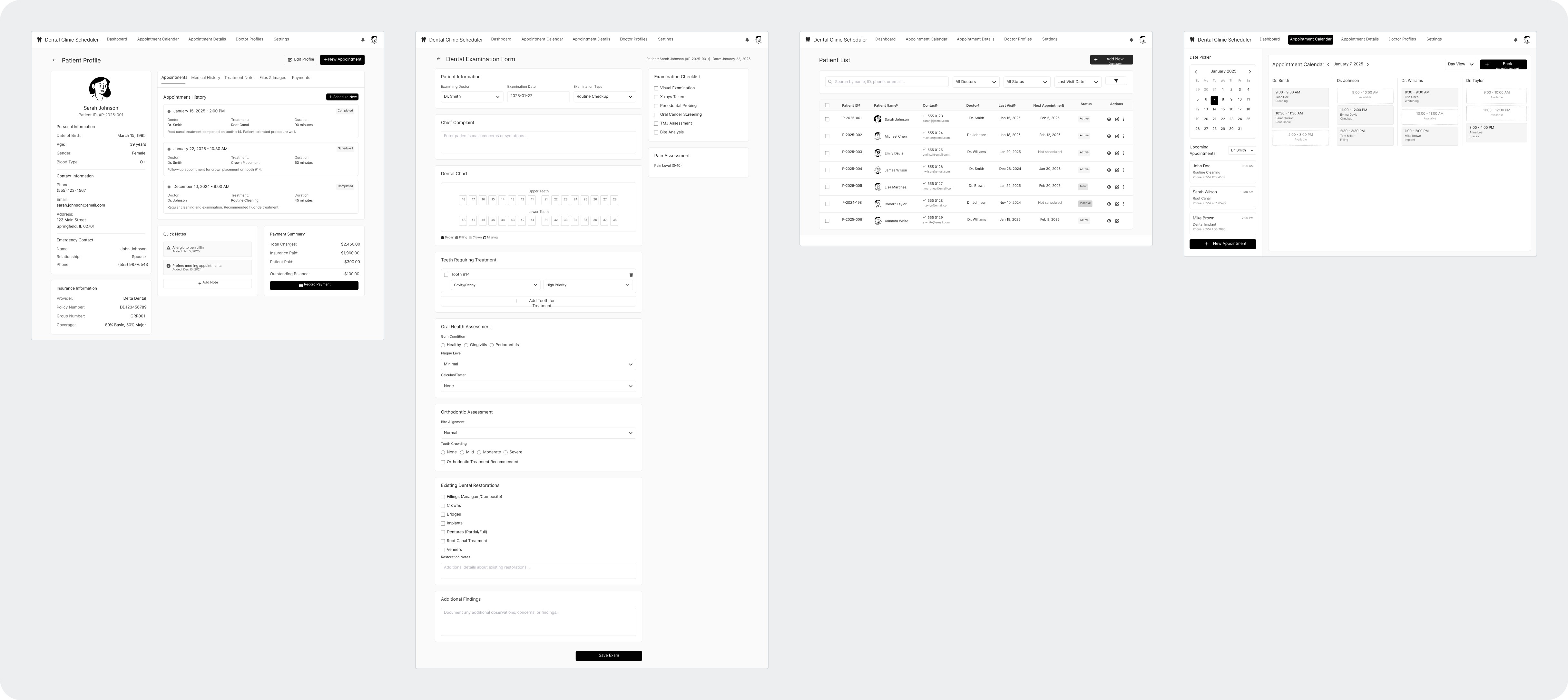
Exemplary wireframes
Exemplary wireframes
Exemplary wireframes
Exemplary wireframes
STEP III
STEP III
STEP III
STEP III
STEP III
Mockups & High-Fidelity Prototypes
Mockups & High-Fidelity Prototypes
Mockups & High-Fidelity Prototypes
Mockups & High-Fidelity Prototypes
At this stage, the greatest attention was given to the most important screens—the home screen, the patient list, and the patient profile—as well as to one of the system’s key functionalities: the creation of an electronic patient card based on a dental examination. Interactive prototypes were then built to simulate real user behavior, allowing us to test how efficiently staff could navigate through patient cards, appointment calendars, and documentation tools.
At this stage, the greatest attention was given to the most important screens—the home screen, the patient list, and the patient profile—as well as to one of the system’s key functionalities: the creation of an electronic patient card based on a dental examination. Interactive prototypes were then built to simulate real user behavior, allowing us to test how efficiently staff could navigate through patient cards, appointment calendars, and documentation tools.
At this stage, the greatest attention was given to the most important screens—the home screen, the patient list, and the patient profile—as well as to one of the system’s key functionalities: the creation of an electronic patient card based on a dental examination. Interactive prototypes were then built to simulate real user behavior, allowing us to test how efficiently staff could navigate through patient cards, appointment calendars, and documentation tools.
At this stage, the greatest attention was given to the most important screens—the home screen, the patient list, and the patient profile—as well as to one of the system’s key functionalities: the creation of an electronic patient card based on a dental examination. Interactive prototypes were then built to simulate real user behavior, allowing us to test how efficiently staff could navigate through patient cards, appointment calendars, and documentation tools.
At this stage, the greatest attention was given to the most important screens—the home screen, the patient list, and the patient profile—as well as to one of the system’s key functionalities: the creation of an electronic patient card based on a dental examination. Interactive prototypes were then built to simulate real user behavior, allowing us to test how efficiently staff could navigate through patient cards, appointment calendars, and documentation tools.
Key elements:
High-fidelity mockups for all main screens
Interactive prototypes simulating clinical workflows
Clear data hierarchy, strong contrast, and accessible typography
Visual direction aligned with medical professionalism
Exploration of multiple UI variations for key components
High-fidelity mockups for all main screens
Interactive prototypes simulating clinical workflows
Clear data hierarchy, strong contrast, and accessible typography
Visual direction aligned with medical professionalism
Exploration of multiple UI variations for key components
High-fidelity mockups for all main screens
Interactive prototypes simulating clinical workflows
Clear data hierarchy, strong contrast, and accessible typography
Visual direction aligned with medical professionalism
Exploration of multiple UI variations for key components
High-fidelity mockups for all main screens
Interactive prototypes simulating clinical workflows
Clear data hierarchy, strong contrast, and accessible typography
Visual direction aligned with medical professionalism
Exploration of multiple UI variations for key components
High-fidelity mockups for all main screens
Interactive prototypes simulating clinical workflows
Clear data hierarchy, strong contrast, and accessible typography
Visual direction aligned with medical professionalism
Exploration of multiple UI variations for key components
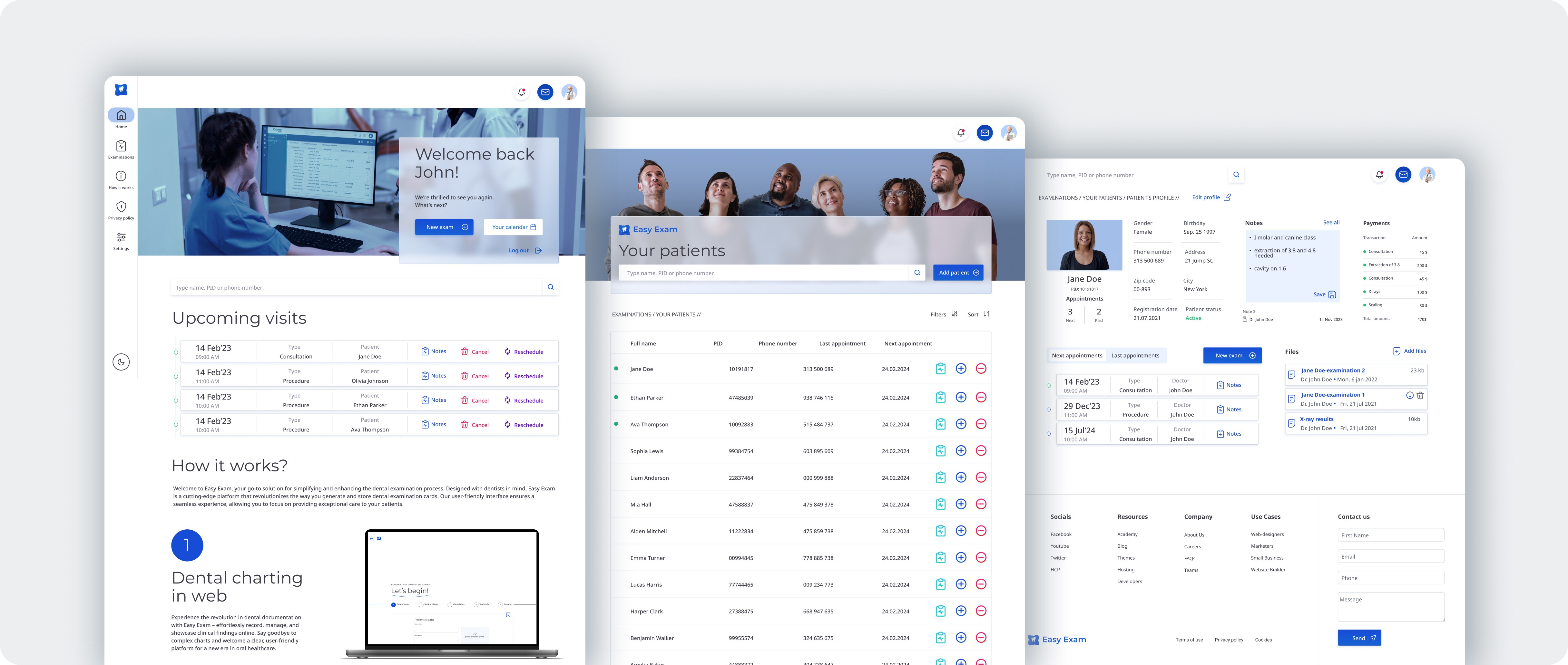
Initial mockups: landing page, patients list, patient's profile
Initial mockups: landing page, patients list, patient's profile
Initial mockups: landing page, patients list, patient's profile
Initial mockups: landing page, patients list, patient's profile
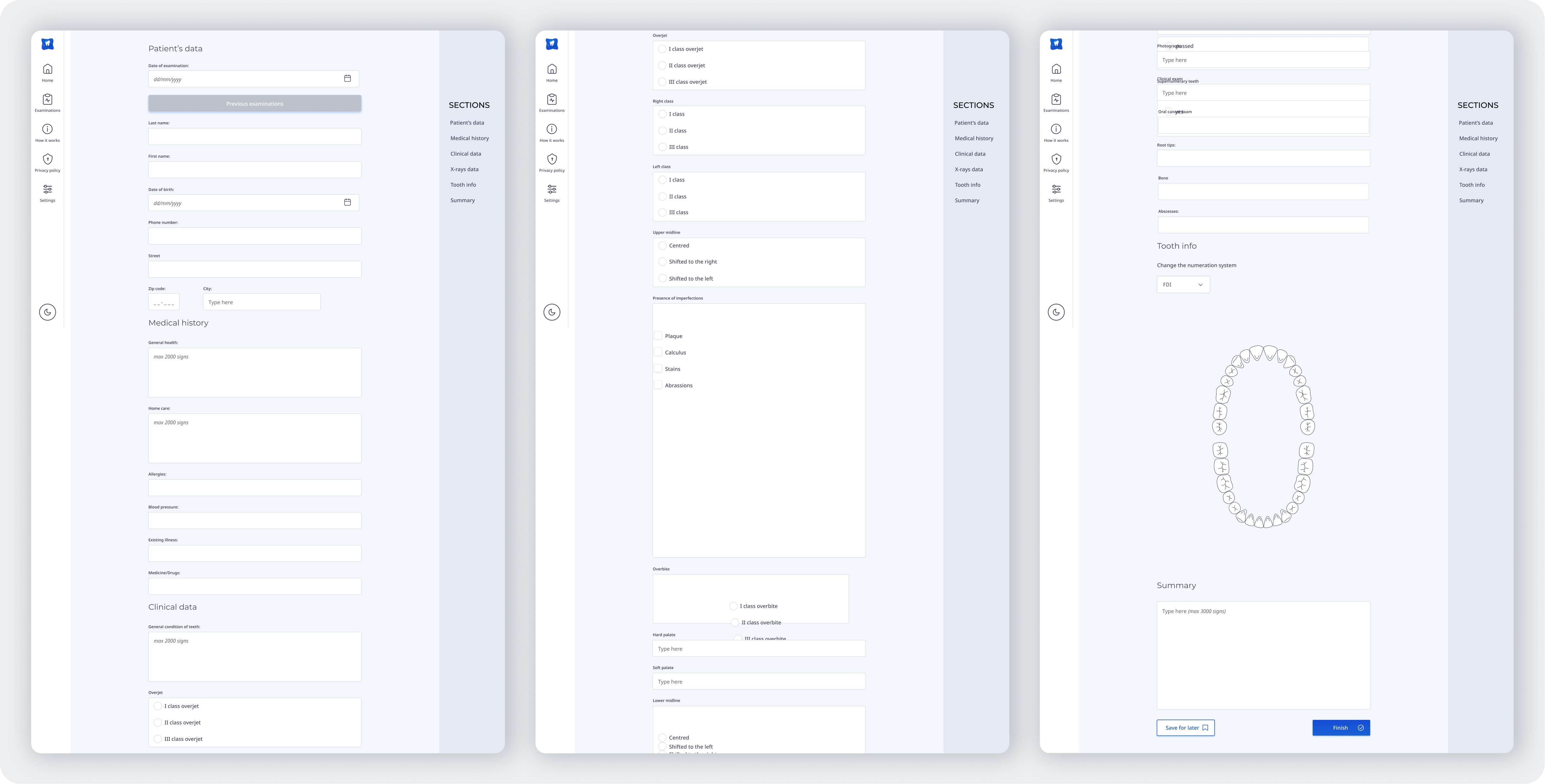
Initial mockups of dental examination form
Initial mockups of dental examination form
Initial mockups of dental examination form
Initial mockups of dental examination form
STEP IV
STEP IV
STEP IV
STEP IV
STEP IV
Usability Testing & In-Depth Interviews
Usability Testing & In-Depth Interviews
Usability Testing & In-Depth Interviews
Usability Testing & In-Depth Interviews
The prototypes were tested with real dental clinic staff representing different roles—dentists, assistants, hygienists, receptionists, and managers. I conducted task-based usability testing to evaluate how quickly users completed core actions such as scheduling a visit or adding documentation. After the tests, I performed in-depth interviews to collect qualitative insights. This provided actionable feedback on what worked well and what required refinement.
The prototypes were tested with real dental clinic staff representing different roles—dentists, assistants, hygienists, receptionists, and managers. I conducted task-based usability testing to evaluate how quickly users completed core actions such as scheduling a visit or adding documentation. After the tests, I performed in-depth interviews to collect qualitative insights. This provided actionable feedback on what worked well and what required refinement.
The prototypes were tested with real dental clinic staff representing different roles—dentists, assistants, hygienists, receptionists, and managers. I conducted task-based usability testing to evaluate how quickly users completed core actions such as scheduling a visit or adding documentation. After the tests, I performed in-depth interviews to collect qualitative insights. This provided actionable feedback on what worked well and what required refinement.
The prototypes were tested with real dental clinic staff representing different roles—dentists, assistants, hygienists, receptionists, and managers. I conducted task-based usability testing to evaluate how quickly users completed core actions such as scheduling a visit or adding documentation. After the tests, I performed in-depth interviews to collect qualitative insights. This provided actionable feedback on what worked well and what required refinement.
The prototypes were tested with real dental clinic staff representing different roles—dentists, assistants, hygienists, receptionists, and managers. I conducted task-based usability testing to evaluate how quickly users completed core actions such as scheduling a visit or adding documentation. After the tests, I performed in-depth interviews to collect qualitative insights. This provided actionable feedback on what worked well and what required refinement.
Key elements:
Task-based usability testing with clinic staff
Observing real-world interaction patterns
In-depth interviews to gather qualitative insights
Identifying friction points and opportunities for improvement
Documenting issues and prioritizing fixes
Task-based usability testing with clinic staff
Observing real-world interaction patterns
In-depth interviews to gather qualitative insights
Identifying friction points and opportunities for improvement
Documenting issues and prioritizing fixes
Task-based usability testing with clinic staff
Observing real-world interaction patterns
In-depth interviews to gather qualitative insights
Identifying friction points and opportunities for improvement
Documenting issues and prioritizing fixes
Task-based usability testing with clinic staff
Observing real-world interaction patterns
In-depth interviews to gather qualitative insights
Identifying friction points and opportunities for improvement
Documenting issues and prioritizing fixes
Task-based usability testing with clinic staff
Observing real-world interaction patterns
In-depth interviews to gather qualitative insights
Identifying friction points and opportunities for improvement
Documenting issues and prioritizing fixes
STEP V
STEP V
STEP V
STEP V
STEP V
Iteration, Refinement & Ongoing Development
Iteration, Refinement & Ongoing Development
Iteration, Refinement & Ongoing Development
Iteration, Refinement & Ongoing Development
Using insights from testing, I refined the system by improving navigation, adjusting layouts, simplifying interactions, and optimizing visibility of the most frequently used features. This stage focused on fine-tuning the experience to support fast-paced work and minimize the chance of errors. The project continues to evolve, with new features being added and the ecosystem gradually expanding to meet the growing needs of dental practices.
Using insights from testing, I refined the system by improving navigation, adjusting layouts, simplifying interactions, and optimizing visibility of the most frequently used features. This stage focused on fine-tuning the experience to support fast-paced work and minimize the chance of errors. The project continues to evolve, with new features being added and the ecosystem gradually expanding to meet the growing needs of dental practices.
Using insights from testing, I refined the system by improving navigation, adjusting layouts, simplifying interactions, and optimizing visibility of the most frequently used features. This stage focused on fine-tuning the experience to support fast-paced work and minimize the chance of errors. The project continues to evolve, with new features being added and the ecosystem gradually expanding to meet the growing needs of dental practices.
Using insights from testing, I refined the system by improving navigation, adjusting layouts, simplifying interactions, and optimizing visibility of the most frequently used features. This stage focused on fine-tuning the experience to support fast-paced work and minimize the chance of errors. The project continues to evolve, with new features being added and the ecosystem gradually expanding to meet the growing needs of dental practices.
Using insights from testing, I refined the system by improving navigation, adjusting layouts, simplifying interactions, and optimizing visibility of the most frequently used features. This stage focused on fine-tuning the experience to support fast-paced work and minimize the chance of errors. The project continues to evolve, with new features being added and the ecosystem gradually expanding to meet the growing needs of dental practices.
Key elements:
Iterative improvements based on test feedback
Streamlining workflows and reducing interaction steps
Enhancing clarity, spacing, and component usability
Expanding features in response to clinic operations
Planning long-term product development
Iterative improvements based on test feedback
Streamlining workflows and reducing interaction steps
Enhancing clarity, spacing, and component usability
Expanding features in response to clinic operations
Planning long-term product development
Iterative improvements based on test feedback
Streamlining workflows and reducing interaction steps
Enhancing clarity, spacing, and component usability
Expanding features in response to clinic operations
Planning long-term product development
Iterative improvements based on test feedback
Streamlining workflows and reducing interaction steps
Enhancing clarity, spacing, and component usability
Expanding features in response to clinic operations
Planning long-term product development
Iterative improvements based on test feedback
Streamlining workflows and reducing interaction steps
Enhancing clarity, spacing, and component usability
Expanding features in response to clinic operations
Planning long-term product development
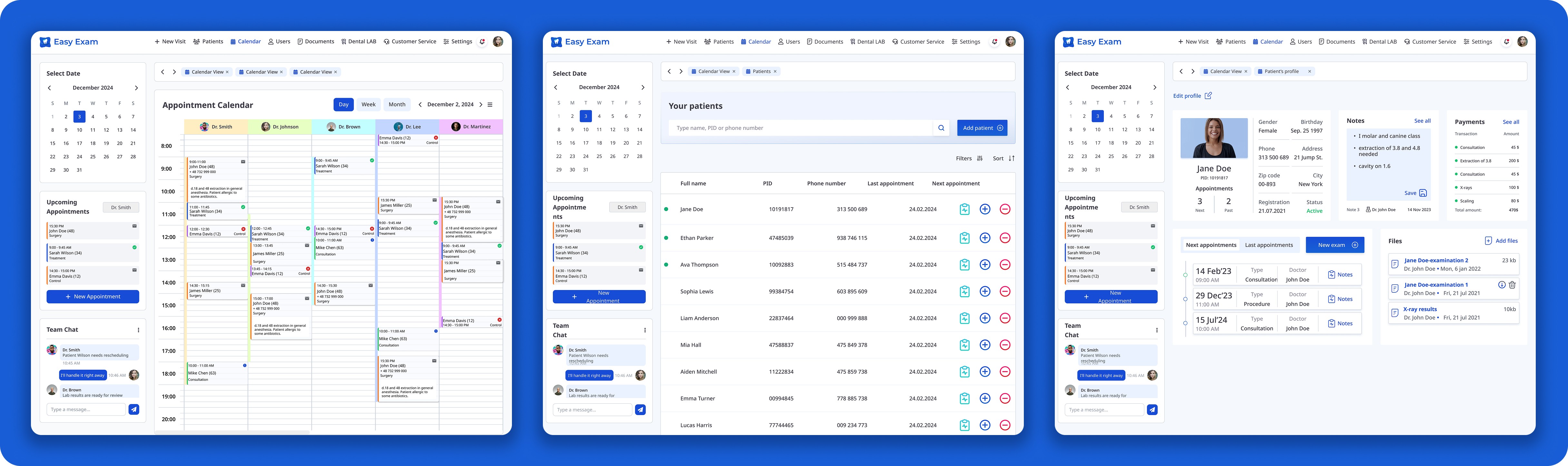
Exemplary mockups of main screens: Home Screen, Patient list and patient profile
Exemplary mockups of main screens: Home Screen, Patient list and patient profile
Exemplary mockups of main screens: Home Screen, Patient list and patient profile
Exemplary mockups of main screens: Home Screen, Patient list and patient profile
Exemplary mockups of main screens: Home Screen, Patient list and patient profile
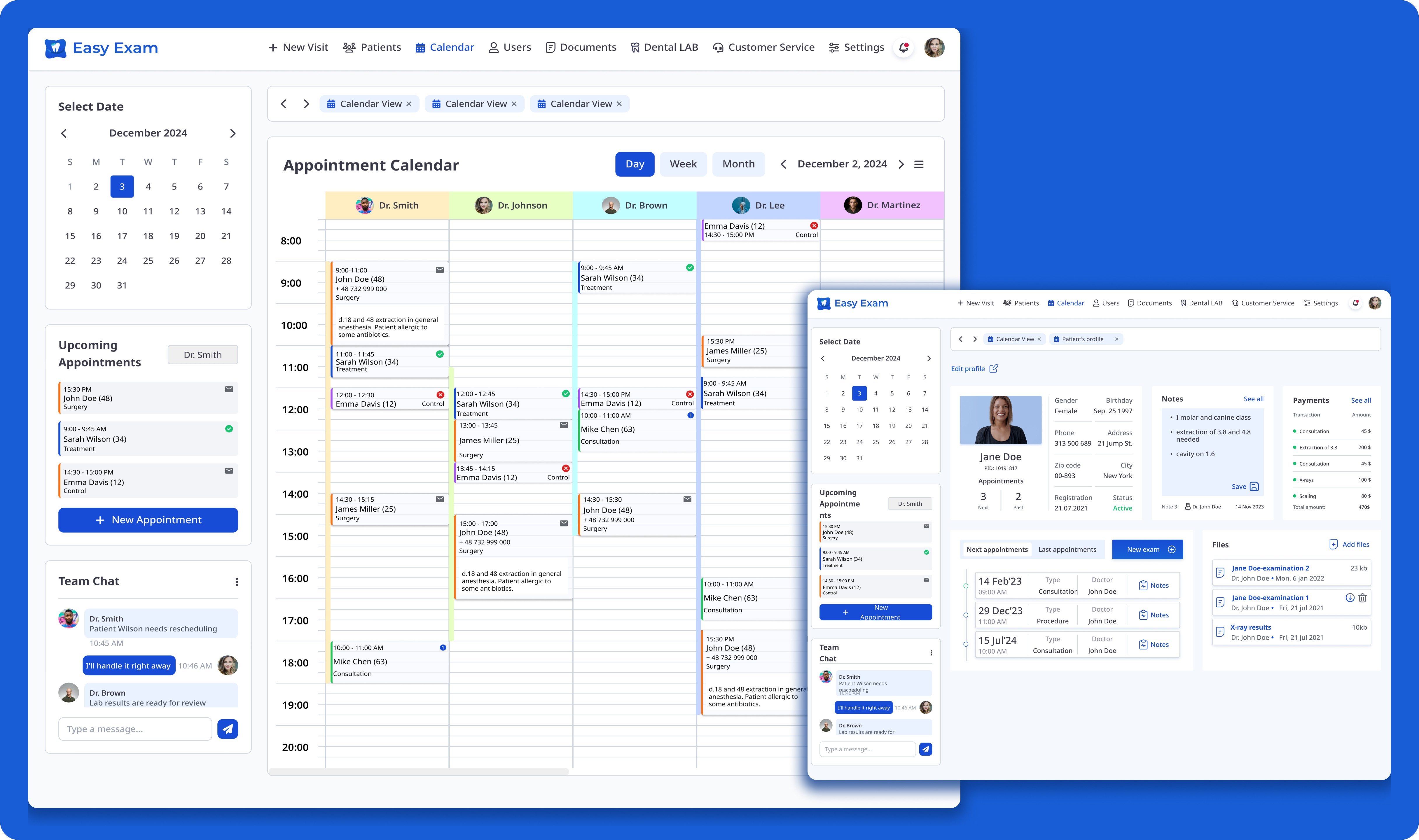
Landing page + patient's profile
Landing page + patient's profile
Landing page + patient's profile
Landing page + patient's profile
Landing page + patient's profile
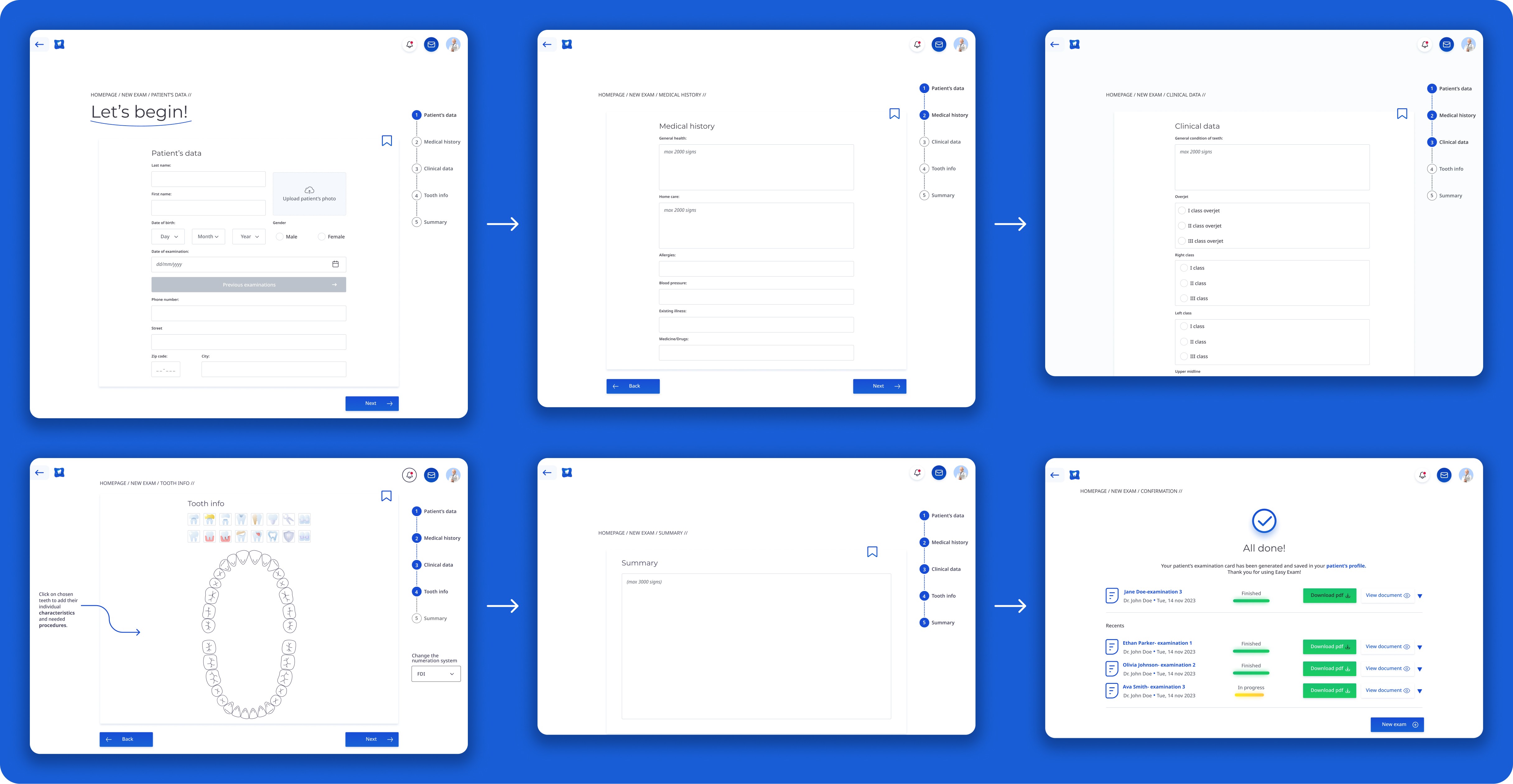
Exemplary mockups, dental examination form, step by step
Exemplary mockups, dental examination form, step by step
Exemplary mockups, dental examination form, step by step
Exemplary mockups, dental examination form, step by step
Exemplary mockups, dental examination form, step by step
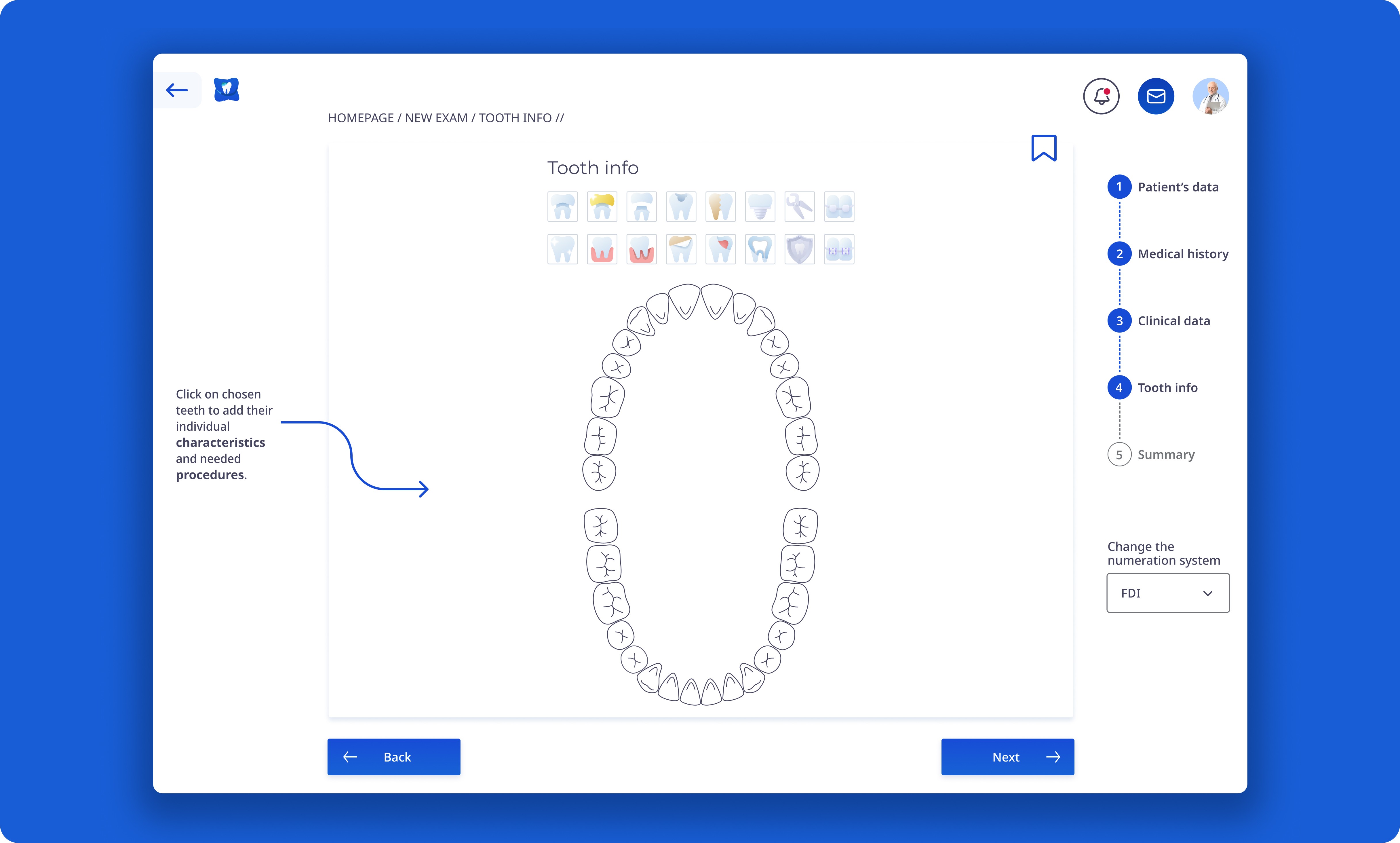
Dental examination form, step 4: marking the teeth that qualify for treatment
Dental examination form, step 4: marking the teeth that qualify for treatment
Dental examination form, step 4: marking the teeth that qualify for treatment
Dental examination form, step 4: marking the teeth that qualify for treatment
Dental examination form, step 4: marking the teeth that qualify for treatment